
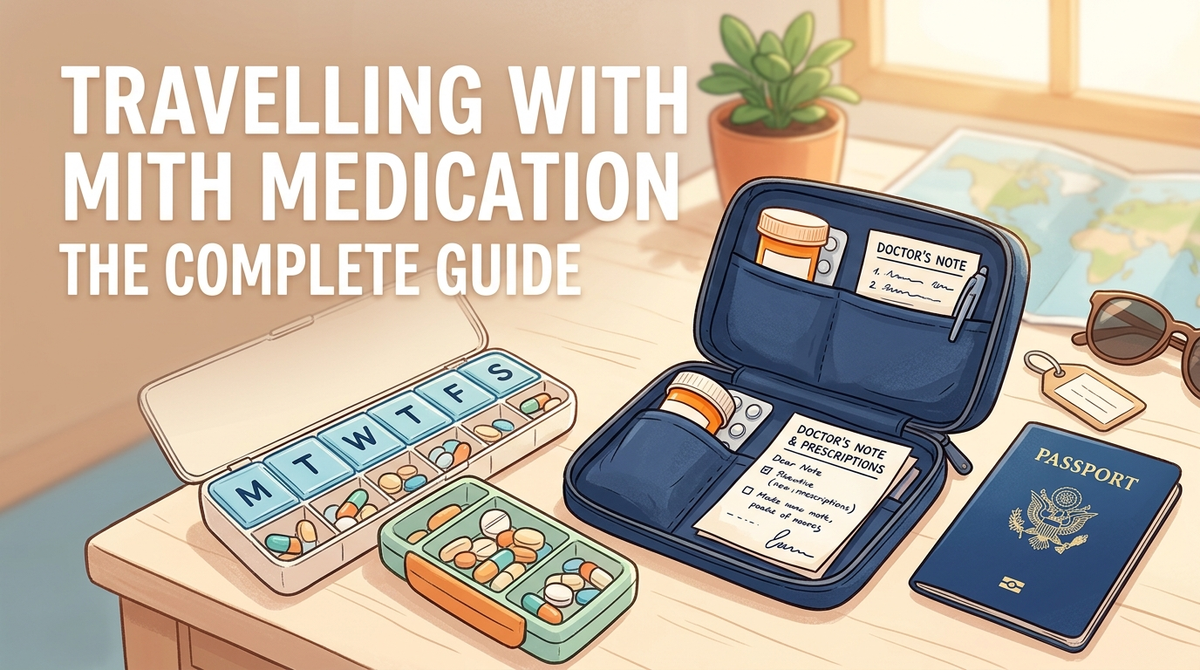
Travelling with medication comes down to three things: keep it organised so you never miss a dose, keep it legal so it clears customs and security, and keep it accessible so it's with you when you need it. A good travel pill organiser handles the first, a few simple documents handle the second, and packing it in your carry-on handles the third. Get all three right and your medication becomes one less thing to think about on a trip.
This guide covers how to choose a pill organiser, how to pack your medication properly, and the rules worth knowing before you fly. It's general guidance to help you prepare — not medical or legal advice, so always confirm the specifics with your doctor and check the official rules for your destination before you travel.

Why a Travel Pill Organiser Makes Sense
If you take any regular medication, keeping it in its original boxes and bottles is bulky, and it's easy to lose track of whether you've taken a dose — especially across time zones when your routine is disrupted. A travel pill organiser solves the day-to-day logistics: it sorts your tablets into labelled compartments so a glance tells you what you've taken and what's still due.
The best organisers are compact, secure (so pills don't spill loose in your bag), and clearly divided by day or dose. A well-made one like the Pocket Pharmacy Organiser keeps a full trip's worth of medication and supplements sorted and protected in something that slips easily into a carry-on. One important note, though: an organiser is for convenience in addition to, not instead of, your original packaging — more on why below.

How to Pack Medication for Travel
Packing medication properly is mostly about being able to prove what it is and having it when you need it. A few rules cover almost every situation:
Keep medication in your carry-on. Never check essential medication into the hold — if your luggage is delayed or lost, you don't want to be without it. Keep it on you.
Bring the original labelled packaging. Even if you use a pill organiser day to day, carry the original boxes or bottles with the pharmacy label too. The label proves the medication is legitimately yours, which matters at customs and security.
Carry a copy of your prescription or a doctor's letter. A copy of your script — or a short letter from your doctor listing your medications and why you take them — is invaluable if you're questioned, especially for anything unusual or injectable.
Pack more than you need. Bring extra doses beyond your trip length in case of delays, and split some between bags if you're travelling with a companion, so a lost bag never means a lost supply.
Keep liquids and sharps in mind. Essential liquid medications are generally exempt from the 100ml carry-on rule but must be declared at security; needles and injectables usually need supporting documentation.

Know the Rules Before You Fly
This is the part travellers most often overlook, and it matters: a medication that's ordinary and legal at home can be restricted or even banned in another country. Some common medicines — including certain painkillers, cold and sinus tablets, ADHD medications, and strong sedatives — are controlled substances in some destinations, and arriving with them without the right paperwork can cause serious problems.
Because the rules vary enormously from country to country, the only safe approach is to check the specific requirements for your destination before you travel. Look at the official government or embassy guidance for the countries you're visiting (and any you're merely transiting through), confirm whether your medications are permitted and what documentation is required, and talk to your doctor or pharmacist well ahead of your trip. This is one area where a little preparation prevents a genuine headache — and where general advice like this article is no substitute for the official rules that apply to your specific medication and destination.
Managing Doses Across Time Zones
Crossing time zones raises a practical question: when do you take medication that's tied to a schedule? For most medications the timing isn't critical and you can simply shift gradually to your destination's clock. But for time-sensitive medications — and particularly anything like insulin or the contraceptive pill — the right approach depends on the drug and the size of the time shift, so it's worth asking your doctor for a simple plan before you go. Setting alarms on your phone in the destination time zone is a reliable way to stay on track once you've landed. A pill organiser helps here too, giving you a clear visual record of what you've taken so a disrupted routine doesn't lead to a missed or doubled dose.
Building the Rest of Your Health Kit
A pill organiser is the anchor of a wider travel health kit. Alongside your regular medication, it's worth packing a small supply of the basics — pain relief, anti-nausea tablets, rehydration sachets, plasters, and any personal essentials — so minor issues don't derail your trip. Keeping the whole lot together and organised means you're ready for the small stuff without a chemist run in an unfamiliar place. For circulation on long flights, our guide on travel compression socks covers another simple health item worth packing, and our carry-on guide helps you get the essentials into your cabin bag.
Frequently Asked Questions
How should you pack medication for travel?
Keep all essential medication in your carry-on, not checked luggage, in case bags are delayed. Bring the original labelled packaging even if you use a pill organiser day to day, carry a copy of your prescription or a doctor's letter, and pack extra doses in case of delays. Always check your destination's rules before you travel.
Can you take a pill organiser through airport security?
Yes, pill organisers are generally fine through security. However, it's recommended to also carry your medication's original labelled packaging and a copy of your prescription, as some countries' customs officials may want to verify what the medication is. The organiser is for day-to-day convenience; the original packaging and documents are for proving it's legitimately yours.
Do I need to keep medication in its original packaging when flying?
It's strongly recommended. While a pill organiser is convenient for daily use, keeping the original labelled boxes or bottles — and a copy of your prescription — helps you clear customs and security, since the label proves the medication is prescribed to you. Carry both: the organiser for convenience and the original packaging for documentation.
Can I bring my medication into any country?
Not necessarily. Some medications that are legal at home are restricted or banned in other countries, including certain painkillers, cold and sinus tablets, and sedatives. Rules vary widely, so you must check the official government or embassy guidance for your destination (and any transit countries) before you travel, and carry the required documentation.
How do I manage medication doses across time zones?
For most medications you can shift gradually to your destination's time, but for time-sensitive medications like insulin or the contraceptive pill, ask your doctor for a plan before you travel, as the right approach depends on the drug and the time difference. Setting phone alarms in the destination time zone and using a pill organiser to track doses both help you stay on schedule.
Travel Prepared, Travel Easy
Travelling with medication is straightforward once you've got a system: a pill organiser to keep doses sorted, the original packaging and a prescription copy to keep everything above board, and your medication in your carry-on so it's always with you. Add a quick check of your destination's rules and a chat with your doctor before you go, and you can travel with complete peace of mind.
Ready to get organised? The Pocket Pharmacy Organiser keeps your medication and supplements sorted, secure, and easy to manage on any trip — backed by our 2-year warranty, 30-day money-back guarantee, and free shipping, from a proudly Aussie-owned team trusted by over 300,000 travellers.
This article is general information to help you prepare, not medical or legal advice. Always consult your doctor or pharmacist about your specific medications and check the official rules for your destination before travelling.

Leave a comment
This site is protected by hCaptcha and the hCaptcha Privacy Policy and Terms of Service apply.